Tuesday, March 9, 2010
Day 3 update: the magical land of spring-break campus
Ok, so today went a little differently than expected...
I read in the morning as usual for this week, but did so at a coffee shop in near campus instead of at home, to mix things up and to get some caffeine into the system. Spring break is a marvelous thing - I didn't have to wait in line at the shop, I didn't have to fight for a table, and I didn't have to wear headphones to drown out the usual crowd of students and others. I got a seat near the fire place AND the window. Magical. Walking around campus is a lot more fun too - fewer cars, fewer maniacal bikers trying to run me over, and fewer slow walkers to dodge (yeah, I'm one of those fast-walking types). The only downside is that the library closes early. Ooops. Guess I'll have to wait another day before delving into the catacombs of hierarchy theory.
Mid-day I showed up at one of my reading groups (having not been prepared enough last week to imply upcoming absence). But it was cool - one of the better little interactions I've had with such groups - everyone was tasked with bringing a single slide containing graphs/analysis of data they've been working on. I think I was the only one that rigidly followed the directions, managing to get 5 graphs intelligibly on a powerpoint slide. It was cool though to hear really succinct tidbits about a real diversity of different projects in progress - I feel like I learned something interesting from each one, which is more than I usually expect.
However, the downside to all of this is that, in addition to taking me away from my reclusive reading for a while, it also got me thinking about my current data analysis project again... and I had new ideas that I couldn't wait to try out. It's possible that I spent pretty much all afternoon tinkering with R code. But my new stuff works decently well (still a bit kloodgy) and I think it will save me a lot of time in the coming weeks, as I've been able to generalize a function so that I can give it in short notation the statistical model that I want to fit, and it will go off and do it for me, without my having to write out explicitly what I want each time with minor variations and new names. Pretty exciting. Now if only I could do it more elegantly.... hmmmm
BEWARE: Caution my dear readers; for those of you not already hooked... programming can get really really addictive. It has a way of inspiring the feeling that the breakthrough you've been waiting for is just around the corner, and then holding out success on you for hours or days on end. In this case, I've got a general formula now that lets me combine multiple linear regression and multiple logistic regression on two different distributions combined in a mixture distribution and fit in one fell swoop by maximum likelihood analysis. Fear me.
Oh, and it makes pretty graphs too.
Tomorrow I will strengthen my resolve and return to another day of reading. It's supposed to be rainy too, so I'll be less inclined to frolic around campus pretending that I don't have to share it with anyone. I'm off to delete a few dozen emails before bed.
Theo out.
Monday, March 8, 2010
Think Week: Day 2
Ok, time for an update on think week - this'll help make me draw my thoughts together. Just got back from a lovely sunny walk to a park down the street... it was nice enough that I wore my spring jacket and sat on a bench in the sun writing for a while! Spring here we come!
At this point I've polished off pretty much all of the articles on the reading list I put up yesterday. Some I read with greater attention than others; several of them are reviews of books that I'm going to get out of the library when it's open again. Together though, they cover about 2 decades of an on-going discussion about whether or not general ecological laws can exist, and if they can what are they, do they matter, and have we found them yet? Lots of comparisons an analogies are made to physics and other disciplines (these are part of the 'physics envy' debate). I think collectively, too, they're part of a (relatively) young field attempting to define and justify itself, something that at least traditional physics has moved beyond long since. Some of these papers were suggested to me during a discussion I had with an empiricist about what theoretical ecology is as a field/discipline (a definition I'm still turning over in my head).
In an attempt to summarize:
Ecology is a complex field. Complexity varies with scale relative to the observer, and just how complex something is relative to our attempts to predict it depends on the number of interacting entities involved, the nonlinearity of their interactions, and the degree of precision desired in predictions relative to the scale of the interacting entities. By way of analogy to physics (as is so often done) - when we deal with systems of many interacting particles, like gases, we can predict their macroscopic properties really well, drawing statistical conclusions and looking at average behaviors. But any physicist would be pretty unhappy about having to predict the exact trajectory of an individual gas molecule, or even a collection of them.
In the same way, as Lawton and others point out, within ecosystems the number of interactions that occur between different species and their environments is large. Broad scale patterns as explained by a growing number of macroecological ideas are somewhat easy to capture, arising out of statistical relationships and generalizations (ie, we can predict general relationships between species abundances and distributions, body size and geographic range, etc). On the other hand, he points out that we're also increasingly good at working with population level dynamics, and developing general principles governing them, like physicists can predict the interactions of a few particles. But we get stuck at the intermediate scale of communities, which are a whole bunch of species interacting locally. A lot of this makes sense and rings true, although I think the outlook for community ecology is a little brighter than he made it seem; we are tracking down relevant mechanisms, and weaving them together and understanding more all the time.
The crux of the matter though, is that making good predictions at the community level is really important, because in many cases, that's where a lot of our visible ecological/environmental problems are taking place. That's the scale that managers work at, and the level at which endangered species are handled often. So some of the greatest need for strong predictions arise at scales that may be fundamentally the hardest to understand and generate predictions for, without the time and resources to do a lot of comprehensive and often case specific studies. Also, a lot of what we find most compelling about ecology are all of the fascinating stories of unbelievable species interactions, incredible organisms and wacky environments. Good thing I like a challenge.
Seems like there's a tricky balance between 1) throwing up your hands despairingly and saying we can never know anything general about communities and will have to studying all of them individually, and 2) looking too hard for a holy grail of generality that may not be feasible. You don't want to get so focused on a particular species or system that you lose all perspective. And at the same time, the only way we're going to get anywhere is by looking at a bunch of deep case studies of communities in particular systems and searching for patterns and interacting mechanisms. How does all of this fit in with the scope and time scale of a PhD thesis? Holy grails take too long and are risky, and organismal myopia is bad for job prospects down the road... I need to figure out how to trace a middle road.
Topical list for tomorrow (Time to start getting more concrete):
- whole lake manipulates by Steve Carpenter et al.
- check out papers, yet to be selected, on microcommunities in pitcher plants and bromeliads
- finish a great conceptual paper on spatial coexistence, drawing together a body of theory (Amarasekare. Competitive coexistence in spatially structured environments: a synthesis. Ecol Letters (2003) vol. 6 (12) pp. 1109-1122 doi: 10.1046/j.1461-0248.2003.00530.x)
- check out this crazy topic I stumbled on earlier, "Hierarchy theory"
- a few papers from the voluminous works of Bob Holt
- having finished off the ~17 papers in my big ideas folder, it's time to take a whack at the 52 in the regular to-read pile.
Stay tuned for more!
Two of the more formative papers from today's reading:
Lawton. Are there general laws in ecology?. Oikos (1999) pp. 177-192
Simberloff. Community ecology: is it time to move on?. Am Nat (2004) vol. 163 (6) pp. 787-799
Sunday, March 7, 2010
Spring Break = Think Week?
Apparently Bill Gates has a long running tradition of holding 'Think Weeks', where he would retreat to a small, remote cottage and spend a week intensively reading papers (to the tune of more than a hundred a week), thinking about up and coming trends in the technology business and how to strategically direct Microsoft over the coming year and beyond. Also drinking lots of orange soda. Check it out here.
I mention this because I've been planning my own variation on 'Think Week' this coming week, coincident with our spring break and a brief respite from coursework. Goals for the upcoming week:
- Try to read everything in my 'To Read' category in Papers (currently sitting at ~52 papers)
- Follow my nose beyond that
- I'm going to start really broad, with a set of commentaries on ecology, theoretical ecology, and where they're heading (the good, bad and ugly), then towards the end of the week start to read more narrowly
Best case scenario, I'd like to emerge from the end of the week having identified:
- 1-3 topical areas that I would enjoy doing a dissertation on,
- 2-3 theories/models related to these topical areas that I could try to test with experiments (and possibly additional theory) over the summer.
This blog is going to be one of the outlets for me to keep myself on task, as well as collect and summarize my ideas a bit. I'll try to post a daily reading list of what I've been looking through each day. Suggestions of other good articles are most welcome.
Here's my queue for today (Big ideas in ecology):

Monday, March 1, 2010
Stumbled upon: "Humpty Dumpty Effect"
Whilst reading a review (Young et al. 2005, Ecology Letters) in preparation for a reading group I might sit in on, I stumbled across the term 'Humpty Dumpty effect'. After a good chuckle, I did a bit more side-track reading to find out about this curious monicker. Check it out, it's pretty cool:
In other brief news, I finished my review of that manuscript and turned it in; we'll see where it goes! It was an interesting learning experience, and I think (hope?) I did a pretty thorough job. I've also kicked out two abstracts for conference presentations; Transient Theorist is going to be at MEEC and ESA this year! (Pending ESA's acceptance, technically). Now I just need to figure out where I want to head with research this summer...
More posts to come towards the end of the week; I've been squeezing in some interesting reading on general theories of ecology, and other articles trying to define what our field is, what it seeks to do, where it's heading and if it will ever get there. Heady stuff. Not sure what I'll have to add to it, but it is really interesting to think about - I should practice defining and justifying my discipline more concretely and more often.
Friday, February 19, 2010
Not again...
It is really discomforting to have your grad advisor tell you that probably you should have chosen a different program/institution, even when it's said with the best of intentions in a friendly manner and a "hindsight is golden" attitude. This is the second time I've heard this from him. It doesn't make a bit of difference now where I could have gone, this is where I am. All that is accomplished by saying that is adding another little dent to my self confidence, which is a little shaky right now as I still have no concrete plans for the summer or a dissertation topic. It's challenging enough for me to stomp out the little voice in my head that says the same thing, without it being aided by external confirmation. Oh well. I'm sure it's not intentional; certainly not his fault that I'm feeling fragile.
In other news, I think I've just about finished writing up this manuscript review. I think it's a little long and I probably have spent too much time on it. Not going to submit it right away, as I want to take another look at what I wrote again tomorrow. I want to make sure I'm not either making what I wrote too harsh or too accommodating due to today's fluctuation in my confidence/anxiety levels. I've got another week anyways; maybe someone will look over it too. Wheeeee!
Tuesday, February 16, 2010
Scientific writing + Plagiarism in different disciplines
So I read through the manuscript that I was asked to review, and I've decided to go for it. It's not directly in an area with which I have tons of experience, but I know enough about it in a general way that I've been able to do some background reading and browsing through the references to get up to speed. If this were a longer paper, one with more technical difficulty, or for a higher level journal, I'd ask for a rain check. But I've decided that I can do this, and it will be a learning experience, and I have to start somewhere. I'm up to the challenge. And hopefully I'll be able to get a reality check/advice from either my advisor or a good friend and post-doc in our lab.
I'm only about halfway through an intensive reading of the manuscript, and it's already raised some interesting challenges and presented me with issues I've never thought about before. I'm feeling more and more like I'll actually have some useful advice and critiques to share. I have suggestions already for improving the intro, extending and clarifying the analysis, and even on a technical aspect of a certain statistical test/related assumptions.
One aspect though is particularly tricky; to summarize (while maintaining confidentiality)...
My big question for this post is: What constitutes plagiarism in scientific literature? (I've heard more than one person refer to the Supreme Court quote "I know it when I see it" during discussions of this topic). I have some previous experience working as a peer tutor for college level english courses. As you might expect, as a discipline, English/Literature seems to me to place much more emphasis on particular sequences of words or phrasings as being the intellectual property of an author. To avoid plagiarism we advised students to substantially paraphrase and reword similar sentences, or to use a cited, direct quote employing lovely punctuation: the ever popular " and ". In this paper I'm reviewing, after looking up references, it has become apparent to me that entire sentences can be traced to previous articles by different authors, almost verbatim (usually with the omissions or substitutions of only a couple of words).
Now I'm left to wonder how big of a deal this is. It makes me uncomfortable because I know it would be a problem for the english students I used to advise, but this is a different context. Scientific writing is necessarily more precise, and often there are fewer alternative ways of saying the same thing. The emphasis in science is on the creativity of research ideas and methods, the ideological content that is conveyed by language, and less so on the creativity of language used for communication.
Further muddying the waters, after looking at several of the citations, its clear that existing papers in the literature also use very very similar language when describing this particular kind of model, although usually these are multiple papers by the same author (not the same group as the one behind the paper I'm currently reviewing, and in better journals by and large). Is it ok to plagiarize yourself? If other papers in the literature use such identifiably similar language, is this standard for the discipline and I just haven't paid close enough attention before?
I think that a really important aspect of plagiarism is intent. Intentional and willful plagiarism without appropriate citations is a much more clear cut situation in my opinion - it's flat out wrong and demands serious consequences. Unintentional plagiarism is more grey, and I think requires more subtlety in its resolution. In this particular case, it's likely that the authors don't speak English as a first language, and there's no obvious intent to disguise the source of the models and ideas as citations are given. If direct quotes and quotation marks were used, I wouldn't blink (except for how rarely direct quotes seem to show up in journal articles). The wording is just soooo similar. Some journals have (relatively) clear policies on this, but not the one I'm reviewing for.
I'd love to hear what you all think... Are standards for plagiarism different in different disciplines? Should they be? And, (this is the part I'm stuck on right now), what is the appropriate role of a reviewer in this kind of situation? What kind of accommodations, if any, should be made due to linguistic and cultural differences in the peer review and publication process, especially as research becomes more and more international?
In upcoming posts I'll say more about this process as I work through it and figure out more about the role of a reviewer.
Theo out.
Friday, February 12, 2010
The hazards of being a scientist
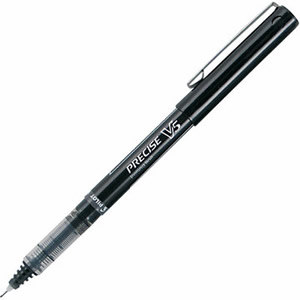
As a graduate student, I do a lot of writing. And when I do mathematics, I really like begin able to write in multiple colors; it helps me see different parts of equations, or pick out particular variables, or make clear thought-graphs. My favorite pens for the last several years have been this kind:
I can get them in packs of 5 or 6 different colors, they're great. Lots of ink, they last a long long time. (Tiny caveat/caution - I no longer take these with me on plane trips to conferences, etc, as the change in air pressure seems to cause them to leak more often than not).
However, as I learned the other day, it's a very bad idea to say, absent mindedly place one of the red pens in your pocket without putting the cap on it first. About halfway through the day I noticed a huge red splotch on the side of my pants. (Not being cool enough/well dressed enough to wear a shirt with pockets on a regular basis, and not having found a pocket protector made for pants, I often carry my pens unprotected in my pants pocket). About half a reservoir's worth of red ink had soaked into my jeans. A stack of paper towels later, I was able to absorb enough of it to not risk staining anything else. But I had to spend the rest of the day walking around looking like my leg was gravely wounded.
The side of my leg is still pink, although I've had some success getting the stain out of my pants surprisingly. I let them soak overnight after rubbing in a baking soda paste, and then washed them with some oxyclean. The next time around, I figured that if baking soda paste worked well, then things could only improve if I rubbed in some baking soda paste and then dumped some vinegar on the stain. I mean, who knows, right? That was always the best course of action back when I was a practicing kitchen scientist. And I have vague notions that maybe the CO2 production will bubble through the fabric and release the ink somehow. Probably crazy... but it sure was fun to mix the two together again!
So, the moral(s) of this story:
1) Always use protection.
2) When in doubt, use vinegar and baking soda.
3) Maybe remember to put pen caps on before jamming pens into your pocket.
Theo out.
Subscribe to:
Posts (Atom)